Chat with us, powered by LiveChat

Dona

Categories
Popular

Donation collection tin vs contactless card donations

Donation Collection Tin vs Contactless Card Donations

Churches and temples have been using collection tins for centuries. One of the earliest instances recorded was from the High Priest in the Temple of Jerusalem. Fast forwarding to the 50’s and 60’s you may remember Debra? She is an early example of a collection box with a begging girl wearing a calliper. Many collection tins and boxes are now valuable historic items.

Wooden life boat donation collection tin

Location

The tins would normally have been on site by the entrance/exit of the church to collect donations
for the upkeep of the building and grounds.

As communities grew, collection tins would be carried around, sometimes with the collector ringing a bell or shaking the tin for attention.

Later they were placed outside shops or on counter tops.

Designs

There were a few famous ones. The RNLI being one of them – from the weird fish to the rocking lifeboat.  The creative fundraisers produced a whole host of fabulous collection tin, boat and box designs that caught the eye of donors around the UK. One of the first original boxes was wooden and dates back to the 1860’s.

Who also remembers Sooty waving on the top of the RNIB charity tins? Or the realistic life-size labrador by the doorway of many shops to collect donations for Guide dogs for the blind.

Of course, they were not all tins, there were boxes, baskets, hats, or even handmade designs that
still did the job pretty well.

From counter top to free standing, charities would compete to tug at the heart strings of the public to boost donations with images, messages and gamification.

Rules and ethics

Although there is no law stopping you from rattling your donation tin it is considered very bad practice in the modern fundraising world. Shaking of the collection tin is strongly discouraged as it can cause public annoyance as well as damaging the tin! It can seem pushy and intimidating and therefore it is explicitly forbidden in most charity fundraising regulations.

There is also a high risk of theft, so regular emptying is essential. Additionally, to the nature of cash donations, it is almost impossible to know how many people have donated and how much.

From loose change to meaningful amounts

We remember as a child being given some coins to pop in the charity box after we had completed our weekly shop. The collection box would whizz the coin around in ever-decreasing circles until it dropped into the tin. We were happy children and our parents gave a little and felt good.

With the development of card machines, the giving of donations has now been added to our totals when we shop on the high street – where we can either accept or refuse the donation – they are rather more thrust in front of us at times with much of the pleasure taken away.

Freestanding contactless terminals give much more privacy and choice with less intimidation. With
the rise in gift aid too, which can amplify our donation.

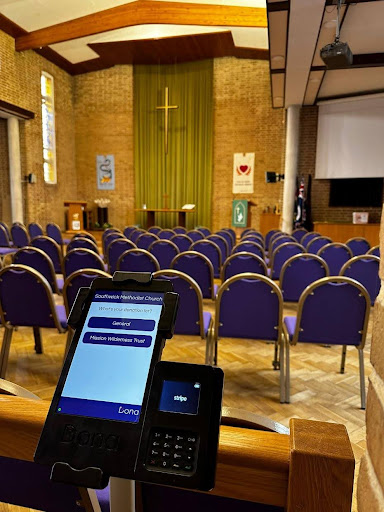
Dona donation terminal in a church with lots of chairs

Collection tin vs contactless card payment

Contactless card terminals are a great way to collect donations without the need to intimidate your donors.  Using a freestanding or countertop terminal, that is self-service, gives the donor choice and can save charities money. 

  • No staff needed 
  • Easy to reconcile
  • Less risk of theft or fraud
  • Increases average donation amount 

Talk to us about how we can help boost your fundraising with contactless card payment terminals 

Call – 0203 488 3095 

Find out more....

Our friendly team will be in touch to answer any questions you may have. 

Categories
Popular

Donors Give Happy: Creating a Seamless Donation Experience

Donors Give Happy: Creating a Seamless Donation Experience

Heart in hands means feeling good donate more

Happy Donors = More Donations!

Can you increase your fundraising totals by simply making the donor experience really easy?

If you can offer a speedy, hassle-free way to donate will it put donors off, or mean they give more and more frequently?


We all know that we feel great when we are able to help someone or give to a charity that
can help on our behalf. But does the actual process of giving need to be lengthy or be an
effort to make it worthwhile?


Our research indicates that an easy donation process can significantly influence our
willingness to give. Here are our top 5 psychological factors that we believe are at play:

1. That Feel Good Factor

  • Pleasure and Satisfaction: Easy experiences often evoke positive emotions, creating a sense of well-being. People are more inclined to give when they feel good. A Harvard Business Review in 2008 stated that the act of giving releases dopamine and endorphins which give us that wonderful positive feeling.
  • Gratitude: When we give or receive a gift, we often feel grateful, thereby boosting
    our happiness, health and social bonds.
  • Passion: Remember that your donors are passionate about your charity, this is why
    they have chosen to donate to your cause. By making the process easy, it shows you
    care about their experience and value their support.

2. Chilling:

  • Effortless Engagement: Easy experiences require less brain power. This frees up to focus on other aspects, such as the act of giving itself or the effect our giving is having on others.
  • Increased Generosity: When we’re not mentally taxed, we’re more likely to think about the needs of others and engage in altruistic deeds.

3. Perceived Value:

  • Enhanced Satisfaction: Easy experiences often lead to higher perceived value and an increase in trust. We associate the product or service with positive outcomes, making us more willing to support them in the future.
  • Loyalty and Advocacy: Positive experiences foster loyalty, increasing the likelihood of repeat donations, more often and with a higher referral rate.

4. Social Sharing:

  • We love to talk: Easy experiences are often shared positively with others. This creates a sense of social proof, encouraging others to participate and give too.
  • Giving is Contagious: Positive recommendations build trust in the charity or organisation, with a ripple effect, making our friends and family more likely to follow with their support.
Two grey haired ladies sat chatting outside about their charity donations

5. Habit building:

Routine and Ease: When an experience is consistently easy, it becomes a habit. Giving can become part of this routine, increasing the likelihood of continued donations. 

At Dona Donations, we love to give our donors an easy process to support their chosen charity.

Contactless card payments mean no need to carry cash and it is quick and easy to ‘tap to donate’.

If your charity could benefit from a boost to your fundraising with contactless card donation
please do contact us today

Categories
Popular

Peace of Mind: Security and Risk Reduction for Charities

Peace of Mind: Security and Risk Reduction for Charities

Charity volunteer lady counting cash donations on a table

Safe and Secure: Can Contactless Donations Protect Your Charity?

The UK ranked 3rd in the world for the amount of money donated to charity in 2022 with 71% of the population being donors*.

Charities can often be subject to theft and fraud with Action Fraud reporting that the total amount lost between November 2022 and October 2023 to be £2,732,170 with over 500 cases.

Charities are reliant on altruism, trust and honesty. There is the risk of theft and fraud that can be either internal or external.  

Internal Charity Fraud

Charity Fraud Report 2023: This report by BDO and the Fraud Advisory Panel highlights that internal fraud (by staff or volunteers) is the most common type of charity fraud**.

While we know that staff and volunteers are crucial to running a charity, there are steps that can be taken to minimise this risk.

If you are a charity concerned about internal theft or fraud please see this resource from the Preventing Charity Fraud organisation. It is an excellent guide to speaking to your volunteers about charity fraud – Speaking to volunteers about charity fraud

External Charity Fraud

The highest recorded examples of external charity fraud in 2022*** were the misappropriation of cash or assets – this was double the number for 2021.

Cash can be stolen from events, charity boxes or on the way to be deposited.  In addition to the loss to the charity, this can be extremely upsetting for staff and volunteers.

Scammers might impersonate your charity and try to collect funds illegally.  Having strict donation policies and appointing a representative to monitor charity collections under the charity banner is just one option.  

Why is it important to protect donors and donations

Reliance on fundraising is crucial to the charity’s survival but are cash collections the best way to collect?

We can access this from both sides – The donor and the Charity.

The donor seeks convenience, security and to feel good about their donation.  The thought of their donation being stolen or not going to the heart of the charity would be devastating and could mean they are less likely to donate in the future.

The Charity would like to raise as much money as possible to be able to fulfil their aims and to operate within their constitution.  A simple, efficient process with minimal risk and clear reporting is ideal, such as an online management portal.

Cash vs contactless charity donations, which is best?

You might be weighing up – Cash vs Contactless payments – which is more secure? This is a question that we are often asked, particularly in the post-COVID era.  Let’s look at more detail about the handling of cash donations.

Older man with cash and a contactless card

Contactless Cards

Advantages

  • Less likelihood of theft or fraud
  • Easy to track
  • Online instant reporting
  • Quick and easy for the donor ‘tap and go’
  • More hygienic
  • Easy to track number and amount of donations
  • Ease of additional income from Gift aiding

Disadvantages

  • Small card processing fee for the charity
  • Less likely to be used for small amounts

Are contactless donations the solution?

The UK is moving towards a cashless society.  Contactless payments utilise a series of security measures like encryption and tokenisation to protect personal or sensitive information.

Taking card payments generally reduces the risk of physical fraud as stolen cash is almost impossible to recover.  

The benefits of contactless donations are clear when we look at the risk to our volunteers, the theft risk and the reporting of donation behaviour.

With more data about our donors, charities are able to make strides to increase the donation amount per transaction, build campaigns in a more informed way, focus on the easy of donating and save on costly staff and admin fees.

If you would like to explore using contactless donations for your charity please contact us –

By phone – 0203 488 8095

Or by filling out our enquiry form

*Charities Aid Foundation – https://www.cafonline.org/about-us/research/caf-world-giving-index

**BDO Charity Fraud Report – https://www.bdo.co.uk/en-gb/insights/advisory/forensic-services/charity-fraud

***Charity Fraud examples – https://www.qlicnfp.com/charity-fraud-examples-you-should-watch-out-for/

Categories
Popular

The Power of Contactless: How Charities Can Raise More

The Power of Contactless: How Charities Can Raise More

Black donation terminal with keypad and easy to tap screen

Why going contactless is one effortless way to boost donations.

Nowadays, fewer than 1 in every 5 payments are made with cash in the UK. There has never been a better time to switch to contactless donations for your charity.

The rise in contactless payments in the UK has been phenomenal since Covid 19 with a record 93.4% of all in-store transactions up to £100 being made with a contactless method of payment in 2023*

In 2023 the average person used their contactless payment 231 times with an average spend over
the year of £3,623**

There is no doubt that contactless is now the quickest and most efficient way for most people to
make purchases day to day. The contactless payment limit was raised to £100 in October 2021 and with Dona Donations terminals the most you can donate in one transaction is £9999.99.

Mobile phone wallets have no specific limits. However, it is wise to check as some providers have a general total card spending limit. Find out more here about general mobile transactions.

Contactless payments continue to be a safe way to make payments with a small reduction in the
amount stolen through payment fraud in 2023 according to the UK Finance Annual Fraud Report
2024.

*According to Frontier Economics
**Barclays, 2024

Contactless cards in gold from visa and mastercard

5 key benefits of taking contactless donations with Dona
Donations

1. Take donations with Contactless and Chip & PIN

2. Collect donations without an internet connection

3. Easy-to-use Management Portal featuring Gift Aid declarations and HMRC
reporting 

4. Secure custom stand options

5. Self-service kiosk with a 10-hour battery life

Most charities can benefit from contactless donations including churches, mosques, temples,
museums, schools, universities, hospices, and food banks. Dona Donations have raised over £25 million for over 2,000 charities thus far.

With 40% of donations Gift Aided, it is the future of fundraising.

Cards accepted include:

  • Mastercard
  • Visa
  • Apple Pay
  • American Express
  • Google Pay
  • Contactless
  • Diners Club
  • Maestro

What does the future of Contactless fundraising look like?

With the use of mobile wallets, digital currencies and banks collaborating to make fintech
advancements at an astonishing rate, we can be sure that tap and go is here for the long run. But
which other areas could we see payments developing into for the future?

Consumer confidence has grown, and card payment is widely accepted as a preferred alternative to cash. With the reduction in risk and the rise in wearable devices, the future of contactless looks likely to grow further with enhanced convenience and accessibility. The technological advancements mean the traceability and reporting now available help to make the running of a charity so much more efficient.

We could see further biometric payments and the need for physical cards decline with some
providers already issuing virtual credit cards. Additionally, QR codes may have finally found their
niche with a huge uptake in the use of this technology for managing business credit card accounts
and taking automatic payments.

Find out more about Dona Donations charity donation plate and how it could help boost your
donations.

Categories
Uncategorized

4 Easy Steps to Set Up Contactless Fundraising

4 Easy Steps to Set Up Contactless Fundraising

June 2024

Boost donations for your charity!

Dona Donations Managing Director Elroy Fernandes talks us through the ease of setting up contactless fundraising terminals for your charity.

The rise of mobile payments has transformed how people give. Cash donations are declining, but with contactless fundraising, your charity can literally ‘tap’ into a whole new world of generous supporters.

Here are the 4 easy steps to get your contactless fundraising up and running:

1. Assemble Your Fundraising Committee: Gather and talk to your committee about how contactless fundraising can be used for your charity as a safe and effective tool.  Speak to us and we can provide you all the costs, savings, and statistics to help you put forward your case to your fellow members.

Some of the most common questions we are asked are:

    1. How much does it cost
    2. Length of contracted commitment
    3. What support is available should there be a technical or user problem?
    4. Which payment cards are accepted?
    5. How long does it take to set up contactless donations?

    Elroy said “The biggest factor is trust, making sure we are helping your charity to make the most of the donations made with low costs and clear transparency.  Ensuring our values also align with your mission and values of your charity as a trusted professional supplier”


    2. Setting Up Your Electronic Donation System: The beauty of ‘tap to pay’ fundraising is its simplicity. We walk you through the entire process, ensuring a seamless integration with your existing donation infrastructure.

    Elroy noted “Nominate a team member that will help us to get you set up,  this is a quick process that is usually handled by your treasurer who can liaise with your bank, we are very happy to help guide you from start to finish”

    3. Promote, Promote, Promote! Once your mobile giving is up and running, let your supporters know! Announce your new donation option on your website, social media channels, and email newsletters. Additionally, you could consider offering incentives for early mobile donors to generate excitement or set a target to reach.

    Person making a Credit card payment for online donation terminal

    Elroy stated “Upon launch, we see a big rise in initial donations as supporters are keen to try the new technology and welcome the opportunity to use a safe method of payment.  Hence, this leads to a rise in the average donations made”

    4. Enjoy Increased Donations & Growing Support: With a card payment fundraising system in place, you’ll be opening your charity up to a whole new wave of contributions. Therefore, Dona terminals make donating easier than ever, allowing your supporters to contribute anytime, anywhere.

    Elroy added “For outdoor activities and events our terminals are perfect.  No Wi-Fi signal is no barrier; we can bring the latest technology to your charity fundraising and keep your team safe with a reduced theft risk.  We also find that charity volunteers like the reduced responsibility of handling cash”

    Remember, we're here to help!

    We have the experience and resources to make your contactless fundraising journey a success. Contact us today to learn more and take the first step towards a brighter future for your charity.

    Enquire
    Categories
    Uncategorized

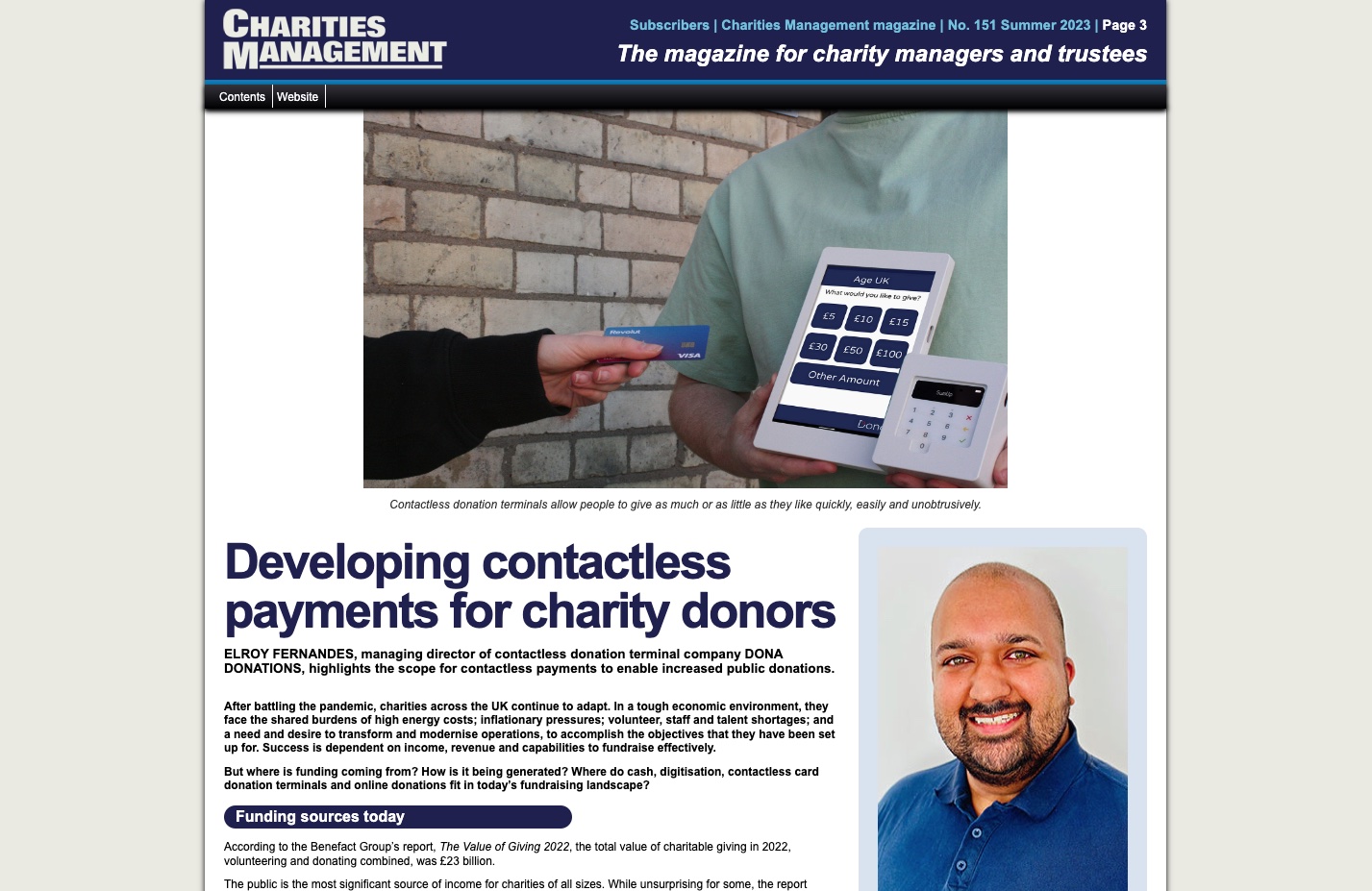
    Developing contactless payments for charity donors

    Developing contactless payments for charity donors

    September 2023

    Exciting News! Rethinking the Future of Charitable Giving

    We are thrilled to share a timely article that our Managing Director, Elroy Fernandes, recently authored, diving deep into the rapidly evolving world of charitable donations.

    “Developing Contactless Payments for Charity Donors”

    In today’s unpredictable economic landscape, charities face unique challenges, from high energy costs to staff shortages. One common thread that can make or break their success? Fundraising.

    Cash or Contactless – Why Not Both?
    While cash still holds its own, the use of contactless donations is increasing at an unprecedented rate. Ever found yourself wanting to contribute to a collection basket but had no cash? Contactless payment is the answer!

    Tech-Savvy Fundraising
    The article also touches upon the importance of embracing technology, especially for small and micro-charities, who rely heavily on public donations. Leveraging digital collection plates not only streamlines the giving process but also offers invaluable insights through data. 

    Gift Aid Simplified
    One of the many advantages of going digital is the accuracy and efficiency in claiming Gift Aid—a cumbersome process when dealing with cash donations.

    Read the full article to get detailed insights: http://charitiesmanagement.com/Magazine-No151/M0L3S/page-3.php

    We are committed to revolutionising the way we think about charitable giving and invite you to join us on this exciting journey! 

    A copy of the article is included below.

    The Dona Team

    Copy of article featuring dona donations director Elroy Fernandes talking about charity donation terminals

    After battling the pandemic, charities across the UK continue to adapt. In a tough economic environment, they face the shared burdens of high energy costs; inflationary pressures; volunteer, staff and talent shortages; and a need and desire to transform and modernise operations, to accomplish the objectives that they have been set up for. Success is dependent on income, revenue and capabilities to fundraise effectively.

    But where is funding coming from? How is it being generated? Where do cash, digitisation, contactless card donation terminals and online donations fit in today’s fundraising landscape?

    Funding sources today

    According to the Benefact Group’s report, The Value of Giving 2022, the total value of charitable giving in 2022, volunteering and donating combined, was £23 billion.

    The public is the most significant source of income for charities of all sizes. While unsurprising for some, the report validates that 62.5% of micro and small charities depend on the public for income. For major charities, this changes to 47.7%. Other sources of income for all charity sizes include government (26%), the voluntary sector (10%), investment (9%), the private sector (4%), and the National Lottery (1%). These figures underscore the vital role that the public plays in ensuring the fundraising successes of charities.

    Cash and contactless

    Within public donations, cash remains king – but it must now share its throne. Mintel’s report, UK Charitable Giving Market Report 2022, says cash is the second largest method of giving (23.13%), after direct debit/standing orders at 51.16%, and ahead of website and apps at 14.61%.

    However, consumer payment methods are changing and the use of physical cash is declining. Statistics from the Bank of England show that transactional cash use has fallen from over 50% of payments in 2010 to only 17% of all payments in 2020, with the trend towards cashless payments accelerating during the Covid-19 pandemic. Yet cash remains the preferred payment method for 21% of the population. Clearly, if charities are to maximise donations, they need to provide opportunity for both cash and, increasingly, contactless and online payments.

    How often, for example, have we walked past a collection basket at a supermarket or village fête with little to no cash in our pockets, wishing we could donate with a contactless payment?

    Additionally, some people may be distrustful and wary about giving cash, out of concern it might not make its way to the charity concerned, and be used correctly. This is where contactless, digital collection plates and online donation webpages can offer a trusted answer. What is more, they allow people to give as much or as little as they like quickly, easily and unobtrusively.

    Most organisations are encouraged to digitise operations, with the UK government actively driving this – and charities are included. Research from Blackbaud, The Status of UK Fundraising, 2022 Benchmark Report, emphasises both the opportunity and the challenge, stating that almost 80% of charities agree technology helps improve supporter relationships; and 67% admit they understand how technology can help. But, at this stage, only 56% are investing in technology, with only 35% saying they know how to optimise it.

    POS versus donation terminals

    Herein lies some of the problem about digitisation – choice and usability. Some charities are exploring contactless payment systems designed for retail. Contactless point of sale (POS) devices used in retail do not accommodate the sophisticated fundraising needs of the charity sector; which must be able to receive donations independently of POS tills and manage Gift Aid.

    A good example of digital collection, used well, can be seen at charity runs like Tough Mudder where contactless terminals have been set up to collect donations , or at Somerset House where these contactless payments are used to support charitable giving on-site.

    Moreover, digital collection plates have been designed to track and present data to charity fundraisers through management portals more effectively than retail POS systems. They provide an array of insights about the state of giving: total amount donated by contactless weekly, monthly and annually, as well as average donations across these time periods.

    This enables charities to understand trends relating to donation locations and times; the actual number of people who have donated; and how many donations have been Gift Aided; and more. They enable relationship building with donors, capturing email addresses in a GDPR compliant fashion; so that charities can continue to communicate beyond the initial point of donation. All of which helps improve the donor experience for the charity too.

    Making contactless work

    As charities consider contactless technologies they should appreciate a few points. On average, individuals donate £12 per time via digital collection plates – a significant amount when the average of all giving, including direct debits and standing orders, is £27 per person per year. Typically, when deploying them, charities recoup investments within a month.

    But achieving success requires strong internet access, either via a WiFi or 4G-enabled system. This is because the system makes secure real-time checks with the banks that cards belong to when payments are made.

    Deciding where to place digital collection plates is essential. They are often the size of a tablet, and can be affixed to floor stands, wall mounts and countertops. Their size and mobility make them ideal for use in an array of settings like shopping centres during fundraising drives; football stadiums; churches; and even the entrances to large corporate offices or co-working spaces. Key to success is making them visible and known.

    Payment data is protected and payments are secure. Terminals are designed so that they cannot be affected by card skimmers. Encryption ensures that if the device is stolen, no money or card details can be retrieved – and, since contactless payments send money to the charity’s bank accounts, no cash can be stolen off-site.

    Practical considerations

    Device power is important to manage. Typically the battery power on devices lasts around 10-12 hours, and is capable of lasting a full day of fundraising. Additionally, depending on how charities use terminals, they can be housed in custom-built, charity-branded kiosks and be connected to power. Alternatively, devices can be swapped and charged when battery power runs out, or just connected to a charging point.

    Aside from this, keeping devices dry is important. Similar to mobile devices they are normally housed in a waterproof casing. This protects them from water or spills. Otherwise, when not cased, if it rains, street fundraisers try their best to stand under umbrellas to protect the devices, or charities try place them in dry locations anyway. For instance, the Lantern Arts Centre, Raynes Park, southwest London, has a contactless device located at the entrance to accept contactless donations from attendees at its theatre shows.

    Further, for these systems to suceed, it is important that charities announce to the public and internal teams that they are using them. Don’t hide them away either. Ensure there is an internal champion who is driving the use of the technology, enabling the charity to achieve the desired fundraising, Gift Aid, data insights, and relationship building potential offered.

    Gift Aid accuracy

    Enabling Gift Aid easily and accurately for charities and donors is key. When people donate cash, charities often have two people counting it together to ensure accuracy, and are required to follow due process when registering it for Gift Aid and HMRC. This can be prone to human error. However, with digital giving the process is quick and accurate. Donation terminals enable donors’ contact details, card information and payment information to be filled in and accepted within a couple of minutes.

    In comparison to cash, accounting for Gift Aid with contactless is straightforward – card transactions are automatically logged correctly according to user and contact details, and management portals allow Gift Aid coordinators to download data in a format ready to submit to HMRC, with the right evidence required to claim Gift Aid. So, when Gift Aid transaction claims are submitted, the evidence is ready to use, accurate and easy to submit.

    Endless possibilities

    The public offers a vital source of funds to charities and digitisation is increasingly important. While cash does remain king, its queen is contactless. However, for these systems to thrive, they need to be complementary to other fundraising strategies as ubiquity grows. They also need to be custom-designed for the nuances of charitable giving – and easy to deploy and use. When harnessed correctly, the possibilities for use are endless.

    Categories
    Uncategorized

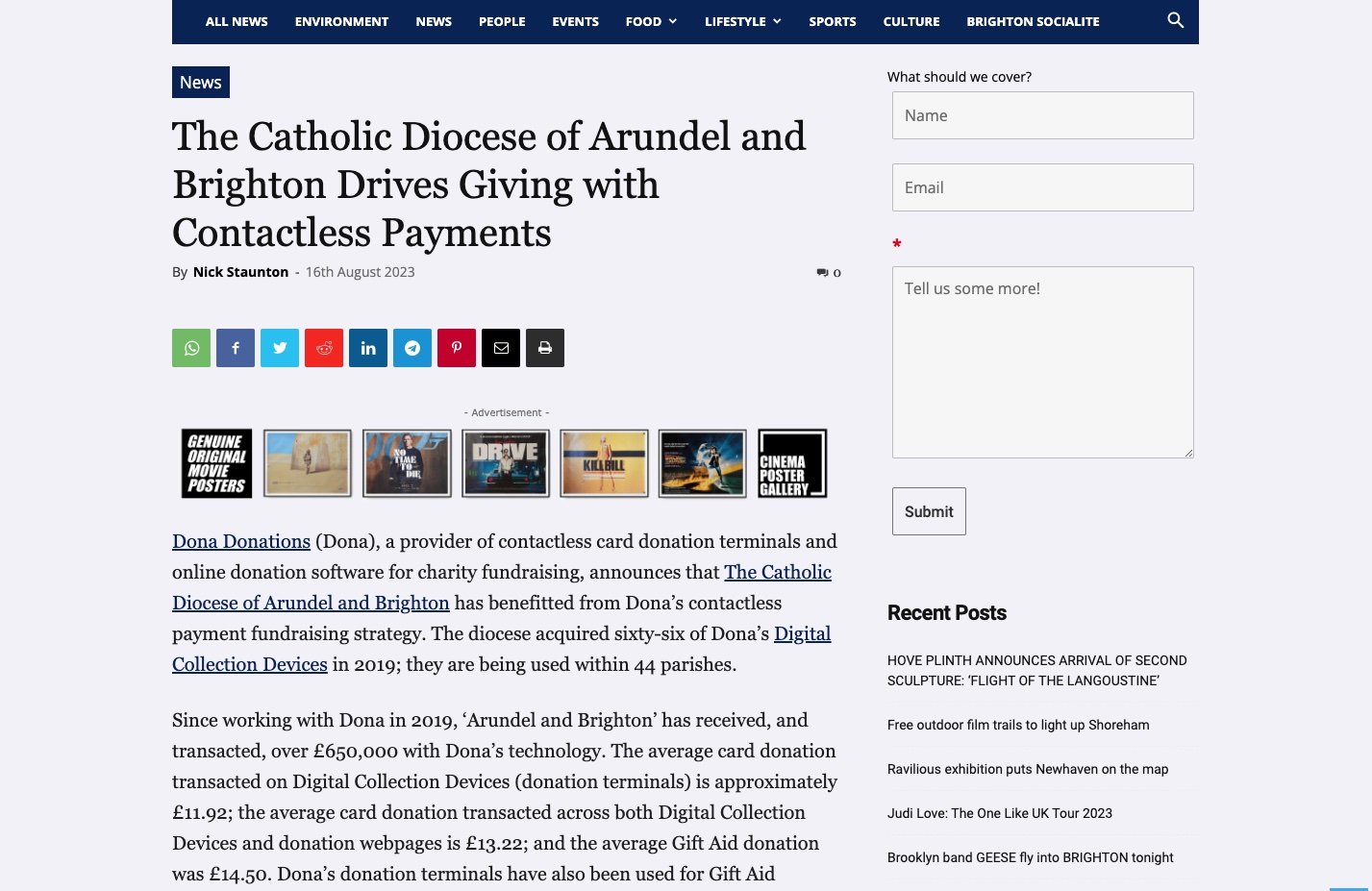
    Arundel and Brighton Diocese’s use of contactless terminals

    Arundel and Brighton Diocese's use of contactless terminals

    August 2023

    **Exciting News Alert!**

    We’re thrilled to share that Dona Donations has been featured in Brighton Journal! The article focuses on our partnership with The Catholic Diocese of Arundel and Brighton, and the transformative power of technology in charity fundraising.

    **Quick Stats:**
    – Over £650,000 raised since 2019
    – Average card donation: £13.22
    – Average Gift Aid donation: £14.50

    The Catholic Diocese of Arundel and Brighton have embraced our technology, deploying 66 of Dona’s Digital Collection Devices across 44 parishes. Since partnering with us, the diocese has raised over £650,000 through Dona’s technology.

    Patricia Wrightson, Diocesan Gift Aid Coordinator, says, “Payments are secure and the funds collected go speedily into the church’s bank account… Gift Aid administration is easy to manage, and the wider reporting functionality supports church finance teams.”

    **Why is this important?**
    The decline in cash usage, exacerbated by the events of 2020, has affected charitable giving across all sectors. Our mission has always been to bridge that gap with easy, secure, and efficient contactless solutions.

    A big thank you to Brighton Journal for featuring us and to the team at The Catholic Diocese of Arundel & Brighton for entrusting us to be a part of their fundraising journey.

    You can read the article here https://brightonjournal.co.uk/the-catholic-diocese-of-arundel-and-brighton-drives-giving-with-contactless-payments/

    A copy of the article is included below.

    The Dona Team

    Article about how Catholic Diocese use dona donations contactless payments for card donations

    Dona Donations (Dona), a provider of contactless card donation terminals and online donation software for charity fundraising, announces that The Catholic Diocese of Arundel and Brighton has benefitted from Dona’s contactless payment fundraising strategy. The diocese acquired sixty-six of Dona’s Digital Collection Devices in 2019; they are being used within 44 parishes.

    Since working with Dona in 2019, ‘Arundel and Brighton’ has received, and transacted, over £650,000 with Dona’s technology. The average card donation transacted on Digital Collection Devices (donation terminals) is approximately £11.92; the average card donation transacted across both Digital Collection Devices and donation webpages is £13.22; and the average Gift Aid donation was £14.50. Dona’s donation terminals have also been used for Gift Aid registrations, Parish Office/Shop transactions, and for donations to third party charities.

    Patricia Wrightson, Diocesan Gift Aid Coordinator, The Catholic Diocese of Arundel & Brighton says, “The use of contactless payments is on a steady increase in the UK and globally. Our diocese is benefiting from using Dona’s technology by providing parishioners within our parishes, and visitors to Arundel Cathedral,  with the option of supporting the work, and mission of the Church, in an easy and modern way using contactless payment donations without the need to hunt for cash; which a high proportion of people generally don’t carry around much today.”

    “We typically place Dona’s Digital Collection Devices at the entrance or exits of our churches and buildings, to enable giving in a way that allows people to donate without disrupting the flow of a church service. Other uses of the Digital Collection Plate include when using a votive candle, which is more secure than a collection box, which can be prone to theft; hall and car park hire; ‘fish-and-chip’ suppers; parish shops and fund-raising for third-party charities.”

    “This technology is relatively easy to use, and for our parish staff or volunteers to set up. Once parishes start using it, they appreciate the benefits and do not look back. Payments are secure and the funds collected go speedily into the church’s bank account. A key benefit of contactless giving is avoiding the counting, storing, and banking of the cash which is time consuming and a potential security risk. We value this, especially with many branches of banks closing. The Gift Aid administration is easy to manage, and the wider reporting functionality supports church finance teams with managing the finances more efficiently too.”

    Dona Donations’ mission is to help charities increase their donation income through technology. Its Digital Collection Plate provides donors access to a self-service kiosk that is contactless, and chip & PIN enabled. Gift Aid donations can be easily set up and managed. Giving can be categorised according to various causes/funds within a charitable organisation. The system is secure, and its management portal makes it straightforward and fast for charities to support accounting procedures and Gift Aid administration.

    Elroy Fernandes, Managing Director, Dona Donations says, “The decline in cash usage by around 15% every year since 2017 – and 35% during 2020 – has generally affected charitable giving across all charities, especially in ad hoc situations such as museum visits or at religious venues, when weddings and funerals have previously generated significant cash collections. Therefore, we’re delighted our Digital Collection Plate is supporting The Catholic Diocese of Arundel and Brighton – enabling contactless donations to take place, providing church goers and visitors to services and functions with more options for donations and giving.”

     
    Categories
    Uncategorized

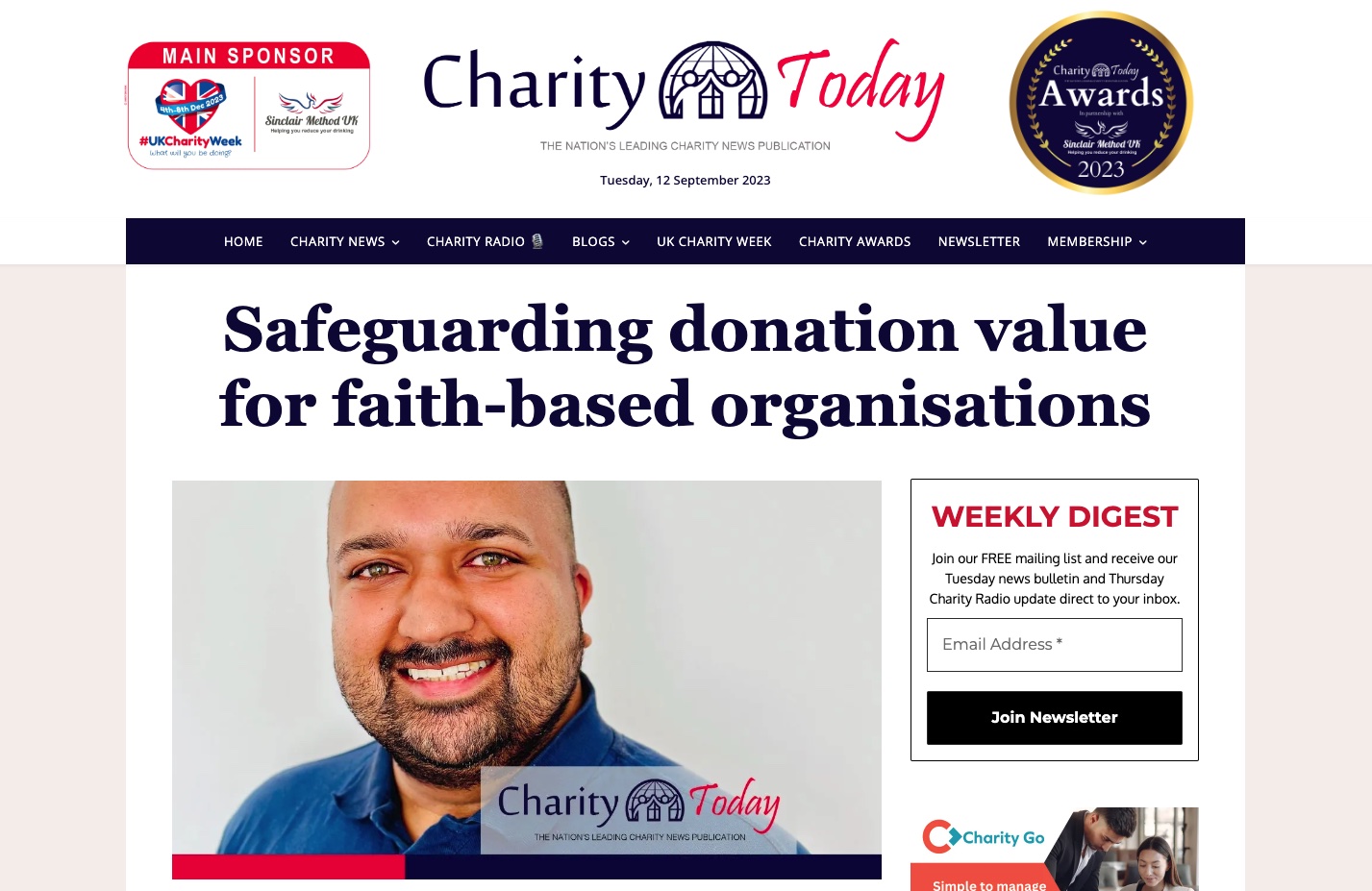
    Safeguarding donation value for faith-based organisations

    Safeguarding donation value for faith-based organisations

    July 2023

    We’re excited to announce that our Managing Director, Elroy Fernandes, was recently featured in Charity Today, where he discusses the transition of faith-based organisations from traditional cash donations to innovative contactless donation methods! 

    In this insightful article, Elroy illuminates the challenges faced by faith-based organisations in a society where cash usage has significantly reduced. However, he believes this shift could also be a silver lining, introducing a new era of secure and convenient giving.

    Our self-service donation terminals, designed with simplicity and flexibility in mind, are becoming the preferred choice for donors. Besides being convenient, these terminals can significantly boost Gift Aid income, increasing overall donations.

    Elroy also highlights how digital donation solutions reduce the risk of theft, fraud, and error, bringing peace of mind to organisations and enhancing trust among donors.

    So, whether it’s regular worship, special events like weddings and funerals, or external fundraising, our terminals ensure a seamless and efficient donation experience, contributing to the sustainability and growth of faith-based organisations.

    Read the full article to understand why the future of donations is contactless and how Dona is playing a pivotal role in this transformation https://www.charitytoday.co.uk/safeguarding-donation-value-for-faith-based-organisations/

    A copy of the article is included below.

    The Dona Team

    Image of Elroy Fernandes from Charity today talking about contactless charity donations terminals

    FAITH-based organisations have historically relied heavily on cash donations from worshippers and while a proportion of regular attendees and community members have transitioned to direct debits and standing orders, the decline in cash usage has devastated overall contributions, especially at weddings, funerals and external fundraising events. But given the risk of cash donations to theft, fraud and error, a move to convenient contactless card donations could have a silver lining, as Elroy Fernandes, Managing Director, Dona Donations, explains.

    Cash Contributions

    With cash used for just 15% of payments in 2021, it is simply no longer viable for faith-based organisations to rely on traditional ways of generating income. The challenge is not simply in ensuring regular worshippers make donations during services, but in capturing the significant additional donations provided by friends and family during emotional events such as baptisms and funerals.

    People still want to donate but when so few carry cash it is vital to provide a simple, convenient alternative. With 97% of the UK population now holding debit cards, the use of self-service card donation terminals is fast becoming the efficient way for individuals to donate.

    These terminals can be located in stands or on tables in convenient places around the place of worship. The simple design allows a faith-based organisation to prompt donors with different donation value options, an approach that particularly helps those unfamiliar with a place of worship to make a donation decision. And, with a one-time Gift Aid registration, faith-based organisations enjoy a far higher level of Gift Aid on donations than typically achieved with cash, adding significantly to overall income.

    Different Approach

    Contactless payment terminals offer a different experience from the traditional cash basket handed around during a service. Indeed, organisations are encouraged to request donations before or after the service, rather than during the traditional time for collection – in part due to the small ‘bleeps’ that ensure sight-impaired people know their donation has been processed, which can be a distraction.

    Any resistance to this small change within a service is typically rapidly overcome by the sheer ease of use and flexibility of this donation process – and its quantifiable value to the organisation. For example, faith-based organisations accepting contactless donations have seen the average value increase to £13, from an anecdotal figure of approximately £2 – £5 in cash, or whatever loose coinage is on a person at any given time. Contactless donations, therefore, help the organisation to capture donations from all visitors – from summer tourists admiring a historic place of worship to individuals using the buildings for other community activities. Indeed, because the terminals can be unlocked and, with the addition of a SIM card, used for other fundraising, such as fetes and community events, that would previously have relied on cash transactions, they can provide a valuable source of donation income.

    Preventing Loss

    The other key benefits of this move away from cash is the significant reduction in the risk of opportunistic theft, internal fraud and error. The times of religious services are widely published, which means potential thieves know exactly when to target a building. With the cost-of-living crisis, anecdotal evidence suggests more faith-based organisations have experienced problems with attempted theft.

    In addition, instances of internal fraud are sadly widespread because cash is so hard to track. While churches have lost hundreds of thousands of pounds to theft undertaken by trusted individuals, including treasurers, in many cases it is a simple error in either counting the cash or updating a spreadsheet that can lead to confusion.

    The use of digital collection terminals completely eradicates this problem. The digital donation information is accurate and verified and automatically updates the financial system in use. In addition to saving time for volunteers in counting cash and updating spreadsheets, the organisation also has accurate reports for the Charities Commission. With the addition of simple, electronic Gift Aid declarations, faith-based organisations can enjoy a far simpler and more accurate process for managing donations.

    Conclusion

    Cash-based giving will continue to decline – especially across the younger generations – and it is therefore vital that faith-based organisations provide a convenient alternative. Contactless payment terminals offer a simple solution to replace all cash interactions that are easy to use and understand for both donors and, critically, the volunteers that keep faith-based organisations running.

    Categories
    Uncategorized

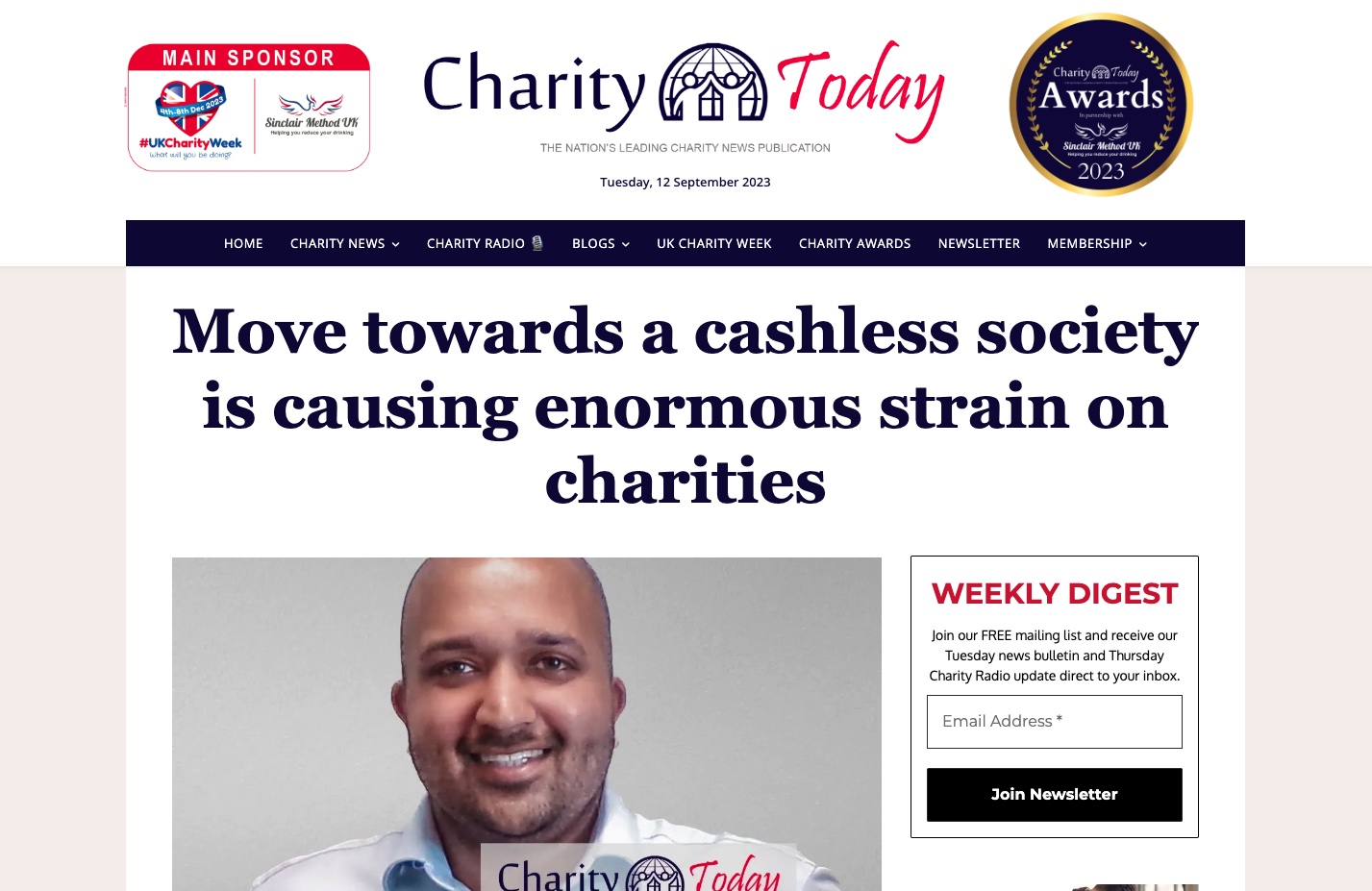
    Cashless society causing enormous strain on charities​

    Cashless society causing enormous strain on charities

    June 2023

    Our Managing Director, Elroy Fernandes, explores the profound transformation happening in the charity landscape. As society evolves towards a cashless economy, it’s crucial for charities to adapt and provide donors with innovative and engaging ways to contribute. 

    Elroy discusses how self-service contactless terminals are proving to be more than a convenient alternative to cash donations, and how they’re sparking a new level of engagement with potential donors.

    Read more about the exciting opportunities contactless donation terminals present for connecting with Trust Based and Impact donors, as well as the key role they play in providing a vital fundraising stream amidst the societal and economic shifts of our time.

    This article featured in Charity Today and be read here https://www.charitytoday.co.uk/move-towards-a-cashless-society-is-causing-enormous-strain-on-charities/

    A copy of the article is included below.

    The Dona Team

    Charity today article about a cashless donations for charities

    MULTIPLE factors are coming together to place enormous financial pressure on charities reliant upon public donations.

    After the disruption and drop in contributions endured during the pandemic, not only has the cost-of-living crisis significantly reduced individuals’ ability to make donations but the creep towards a cashless society is devastating both the planned and impromptu cash donations that have traditionally provided an essential fundraising stream.

    It is now vital for charities to offer potential donors another option – and to find a way to motivate and inspire giving from both regular and occasional donors. Elroy Fernandes, Managing Director, Dona Donations explains how contactless payment terminals are not only providing a convenient alternative to cash donations but also the opportunity to engage emotionally with potential donors.

    Financial Pressure

    Charities are experiencing a year-on-year decline in donations: people in the UK gave £10.7 billion to charity in 2021, a significant drop from £11.3 billion in 2020. Personal financial pressures are also leading one in eight donors to consider cutting back or reducing donations to charities. The decline in cash usage by around 15% every year since 2017 – and 35% during 2020 – has also affected giving, especially in ad hoc situations such as museum visits or at religious venues, when weddings and funerals have previously generated significant cash collections.

    Overall donations may be down in recent years but the fact that the war in Ukraine prompted the largest donation average ever recorded, with one in three people donating, demonstrates that individuals are still highly motivated to support causes they believe are truly important. So how can charities achieve a strong emotional engagement with potential donors?

    In response to the decline in cash, growing numbers of charities have embraced self-service card donation terminals to provide a simple, convenient way for individuals to donate. But this is not just a straight ‘cash for contactless’ swap – with the right approach, charities can achieve a new level of engagement and motivation to achieve an incremental increase in donations.

    Emotional Connection

    The motivations of donors typically fall into one of three reasons: Wanting to improve things for others, having a tangible positive impact or ensuring others do not suffer or have a negative experience. Within these motivations, there is a growing focus on two donor personas: the Trust Based Donor and the Impact Donor. Both want to know how the charity is going to use the money, who is being helped and by how much – and the onus is on charities to find the best ways to inform and thus engage these individuals. 

    Self-service contactless terminals can be designed to engage potential donors in different ways. In addition to providing a number of suggested donation values, they can also include information about the way each donation will be used. For example, a picture of the stained window that needs to be repaired, with the amount outstanding required. Information about the cost of maintaining a building each day, even the different ways each donation value would be used – such as £5 to feed a child for a day or £20 to provide one night in a homeless shelter. 

    Providing a link between a donor and the difference the money will make to an individual, group or even historic location is increasingly recognised to be far more compelling than a generic ‘donate now’ option. It provides people with a sense of emotional engagement and real commitment to a specific cause and, with measurable donation options, a chance to choose exactly how they want to help.

    Convenience and Simplicity

    The entire contactless model is designed not only to be incredibly simple and easy to use but also to maximise donations. Contactless terminals can display up to six different donation options – including ‘other’ – which helps donors to decide how much to give. On average, individuals donate £12 each time at a terminal, which is a significant amount when the average of all giving, including direct debits and standing orders, is £27 per person

    With a simple, one-time Gift Aid opt-in, this approach also significantly boosts the charity’s Gift Aid contributions – with around 40% of contactless donations including the additional 25% Gift Aid.  In addition, while every donation can be made anonymously, the addition of a GDPR-compliant Marketing Opt-In also provides charities with a chance to capture donor information for future communications. 

    Positioned conveniently at locations throughout a building, these terminals can even be encased in stands that are sensitive to the building’s history and purpose – something that is especially important in historic locations that can benefit from significant tourist contributions.  In addition, they can also be unlocked and, with the addition of a SIM card and 4G connection, used at different locations to support other fundraising activities, such as fetes, bake sales and festivals.

    Conclusion

    Offering an alternative to cash donations is a priority in today’s cashless society; but, in many ways, it is the way charities use these terminals to share information with donors, offering a way to boost engagement and inspire additional donations that is the most valuable aspect of the contactless solution. 

    There is no doubt that the donation landscape has changed dramatically in recent years, but there is reason for optimism. Younger generations are increasingly committed to good causes, with 16-24-year-olds showing an increased willingness to donate despite their typically weaker financial capability when compared to over-65s. They also show a lot of interest in innovative methods of donating and engaging with charities, such as using apps, contactless donation points in public spaces and virtual reality at fundraising events.

    With the right approach that combines convenience with inspiration, charities can continue to engage both individuals and communities and attract the ad hoc donations that will remain a key contribution to overall revenue.

    Categories
    Uncategorized

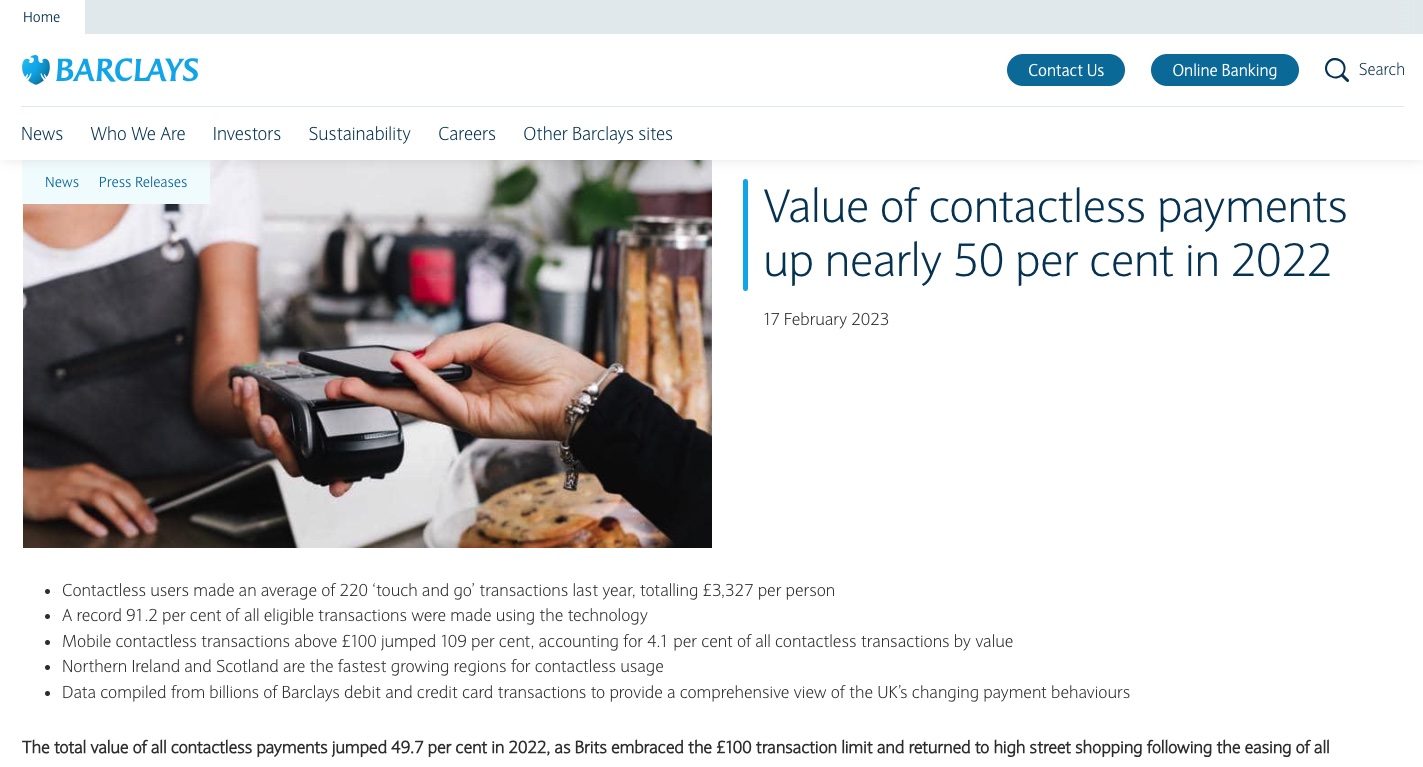
    Contactless payments up nearly 50 per cent

    Contactless payments up nearly 50 per cent

    May 2023

    This is one reason why we are passionate about helping charities adopt collecting donations with contactless payments…

    New data from Barclays reveals that a record-breaking 91.2% of eligible transactions in the UK were made using contactless payments last year.

    This trend is set to continue as Brits continue to embrace next-generation technology in buying and selling, transforming the way we fundraise in the UK.

    The data, compiled from billions of Barclays debit and credit card transactions, also shows that mobile contactless transactions above £100 rose by a staggering 109%.

    Click the link below to read more about the rise of mobile wallets, the increase in high-value transactions, and the growth of contactless in various sectors.

    https://home.barclays/news/press-releases/2023/02/value-of-contactless-payments-up-nearly-50-per-cent-in-2022 

    The Dona Team

    Image of article by barclays showing contactless payments up nearly fifty percent